Pet hair does not care what you spent on a vacuum. It lands on the stairs, the couch skirt, the strip of floor beside the bed, and the one hallway a robot somehow always misses. That is why the useful question is not which machine wins, but how stick vacuums and robot vacuums split the work in a house with animals.
I clean homes professionally, and the households that stay ahead of shedding are rarely the ones with the fanciest single machine. They are the ones where the tools match the job. A corded stick for the three minutes of chaos after a dog drags in half the yard. A robot for the daily pass that keeps hair from turning into felt under the sofa.
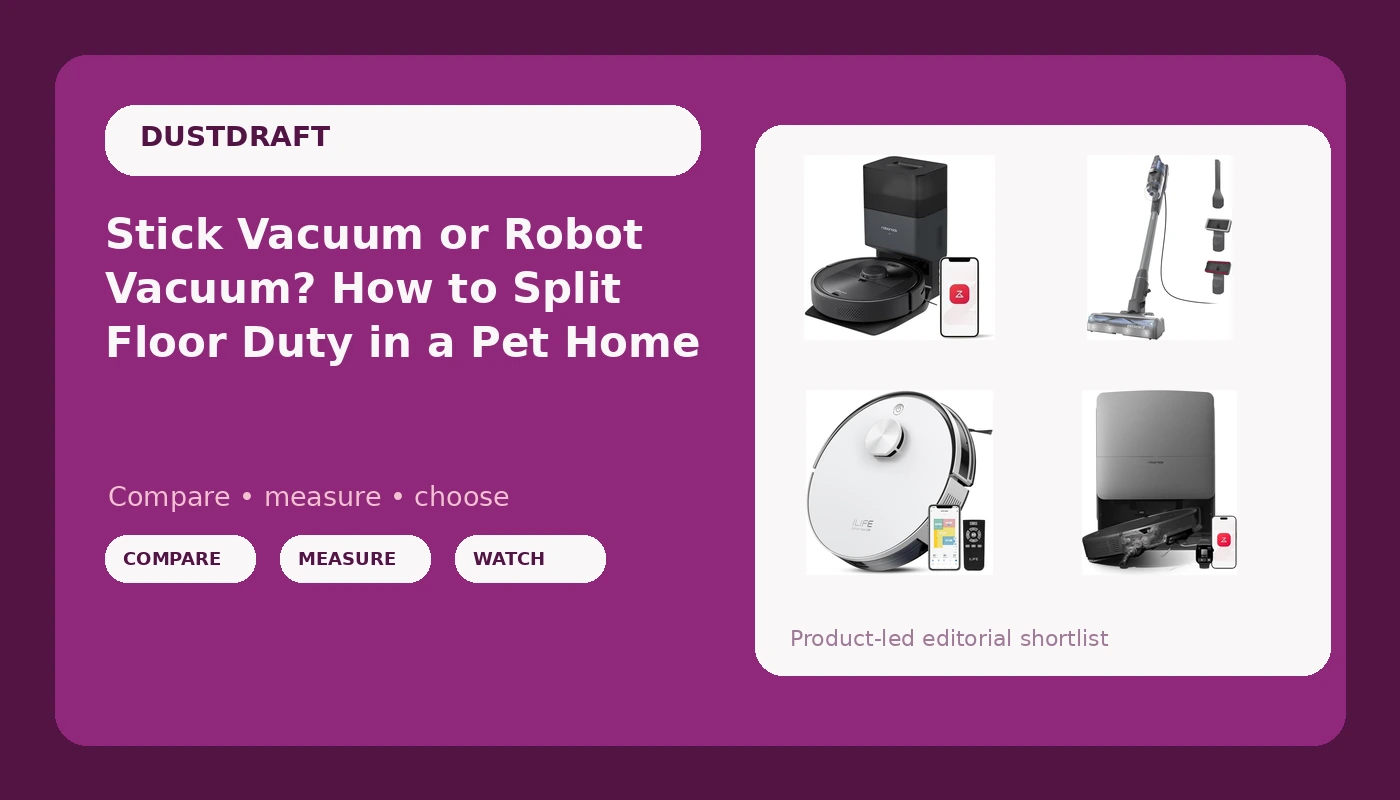
This explainer walks through four options at very different price points and form factors: a corded pet-focused stick, a budget robot, a robot with a self-empty dock, and a robot vacuum and mop combo. No current prices, no invented test scores. Just what each design is actually for, and how to tell which gap in your routine you are filling.
Related: How to Empty a Vacuum Bin Without Touching the Dust →
Quick answer
Buy the tool that matches the mess you keep ignoring. If stairs, upholstery, and sudden pet-hair emergencies are the problem, a corded stick vacuum is the direct answer, because there is no battery to run down halfway up a staircase. If the open floor is the problem and you want it handled without your involvement, a robot vacuum is the right shape of tool. The differences between the robots here come down to dock behavior, suction as listed, obstacle handling, and whether mopping is part of the job.
The four options below cover those gaps. None of them replaces the others, and the big suction number on the box is the least reliable part of the decision.
Four useful options
| Model | Best fit | What stands out |
|---|---|---|
| Bissell PowerClean FurFinder Corded Stick Vacuum, HEPA, 4282K | Stairs, upholstery, and spot cleanups where a cord is not a dealbreaker | Corded stick design with HEPA filtration listed |
| ILIFE A30s Robot Vacuum, 10000Pa Max Suction | Daily upkeep on open floor with a lower entry point | 10000Pa max suction as listed |
| roborock Q5+ Robot Vacuum with Self-Empty Dock, Hands-Free Cleaning for up to 7 Weeks, 2700Pa Max Suction, 180mins Max Run-Time, Compatible with Alexa(Renewed) | Hands-off daily cleaning between manual passes | Self-empty dock listed at up to 7 weeks, 180 minutes max run time, Alexa compatible, Renewed |
| roborock Saros 20 Robot Vacuum and Mop, 36000 Pa, 300+ Obstacle Avoidance | Hard floors plus mopping, in rooms with furniture and clutter | 36000 Pa listed suction and 300+ obstacle avoidance |
The corded stick: Bissell PowerClean FurFinder Corded Stick Vacuum, HEPA, 4282K
The trade-off here is the cord itself. You get unlimited working time, but you also get an outlet to find, which matters on a staircase landing or in a car. For most pet homes that is a fair swap, because the jobs a corded stick is best at are short: the fur tumbleweed by the door, the couch cushions, the stairs the robot cannot climb, the litter tracked three feet from the box. HEPA filtration is worth noting for anyone with allergies, since it describes what the machine is designed to trap rather than how much air it moves. This is also the kind of vacuum you can hand to a helper without a briefing, because there is nothing to charge and nothing to pair with a phone.
The budget robot: ILIFE A30s Robot Vacuum, 10000Pa Max Suction
A robot at this level is not trying to replace your stick vacuum, and it should not be asked to. What it does well is frequency: hair that gets picked up every single day never gets the chance to weave itself into a rug. What it does not do is solve stairs, couch upholstery, or the corner behind the dog crate. You also handle the bin yourself, which is the honest difference between this tier and the one above it. In a home with one shedding animal and mostly hard floor, a budget robot plus a corded stick covers more ground than one expensive machine ever will.
The hands-off daily driver: roborock Q5+ Robot Vacuum with Self-Empty Dock
The dock is the whole point of this configuration. Emptying a small robot bin by hand every day is the step that makes people stop running their robot, and a self-empty dock removes that friction for weeks at a time. Notice the listed suction, though: 2700Pa is far below the other two robots here, and it is still the model many homes would be perfectly happy with, because daily passes beat one heroic pass. That gap is the best argument for ignoring spec-sheet bragging rights. The Renewed label is the other thing to weigh, and it is not a small footnote. Renewed stock varies, so read the specific listing for condition, included accessories, and warranty terms before you buy, and treat the seller's description as the source of truth rather than an assumption about what arrives in the box.
The vacuum and mop combo: roborock Saros 20 Robot Vacuum and Mop, 36000 Pa, 300+ Obstacle Avoidance
Obstacle avoidance is the spec that actually changes daily life in a pet home. Shoes by the door, a water bowl, a chew toy, a charging cable, a cat that refuses to move: a robot that navigates around those without eating them is a robot you can run while you are out. The mopping half of the job is genuinely useful on hard floor, and genuinely pointless in a house where every room is wall-to-wall carpet, so be honest about your floor mix before paying for the capability. This is the highest entry point of the four, and the listed suction figure is enormous. Whether that translates into a difference you can see on your own rugs depends on your carpet, your passes, and your maintenance, not on the number alone.
Prices and availability may change. Product images, names, and retailer links are matched to verified listings. No current price, rating, stock status, or measured result is stated here without current evidence.
Why max suction and run time numbers mislead
Max suction is a peak figure. It describes the best a machine can do under favorable conditions, often in a short burst mode that no one uses for an entire room. It says nothing about airflow through a loaded filter, nothing about how a brush roll performs on medium pile, and nothing about what happens when the bin is half full.
That last point matters more than most shoppers expect. Dirt separation is what keeps suction alive as a bin fills. When the cone system in a bin works well, the airflow path stays open and the machine keeps picking up. When it works poorly, the same vacuum that felt strong on an empty bin starts leaving grit behind on the second pass. A vacuum that only performs when it is spotless is not a vacuum you will enjoy owning.
Run time is measured the same way. A listed 180 minutes is a maximum, usually achieved on a bare floor with an empty bin and a low power setting. Thick carpet, a full bin, and a boost mode all cut into that number. If your actual clean takes twelve minutes, a long maximum matters less than whether the machine finishes those twelve minutes strong.
Filtration deserves the same skepticism in the other direction. HEPA is a meaningful label for allergy sufferers because it describes what the machine is designed to capture, not how powerful it is. A sealed system with good filtration and moderate suction can leave a room feeling cleaner than a stronger machine that leaks fine dust back into the air.
How to choose your setup in five steps
Before you compare anything, walk your own house with this list in mind. It takes about ten minutes and saves a lot of regret.
- Map the surfaces. Stairs, upholstery, car interiors, and tight corners need a handheld or stick format. Open floor, hallways, and under-bed strips are robot territory. Most pet homes need both shapes, not one perfect machine.
- Decide how much of the job you want to do yourself. If you want the daily pass to happen without you, prioritize a robot. If you want the three-minute emergency cleanup to be effortless, prioritize a corded stick you can grab without checking a battery.
- Time your real clean. Not the marketing number, the actual minutes. If your routine is a quick pass on the main floor, a longer listed run time is not buying you anything.
- Check the emptying routine. A bin you can empty one-handed over a trash can wins. A self-empty dock pushes that chore out to weeks at a time, which is the single biggest quality-of-life difference between robot tiers.
- Match the tool to the debris. Pet hair, tracked litter, and cereal crumbs behave differently. Hair wraps brush rolls, so tangle behavior matters. Fine dust rewards filtration. Mopping only helps if you have hard floor to mop.
Living with both without doubling your work
The failure mode with a stick plus a robot is not the hardware, it is the routine. A little structure keeps both tools earning their space.
- Run the robot on a schedule you never think about, ideally while you are out of the house or asleep.
- Keep the stick where the mess happens, not in a closet at the far end of the house. A vacuum you have to fetch does not get used.
- Clear the robot's path before you leave. Cables, pet toys, and stray socks are the usual reasons a run ends early.
- Empty and rinse what the listing says to empty and rinse. Suction that fades is usually a maintenance problem, not a motor problem.
- Do one manual pass a week on the robot's blind spots: stairs, upholstery, corners, and the strip along the baseboards.
Which option should you choose?
Choose the Bissell PowerClean FurFinder Corded Stick Vacuum, HEPA, 4282K when stairs, upholstery, and fast pet-hair cleanups are your recurring problem and you want a machine that never needs charging. Choose the ILIFE A30s Robot Vacuum, 10000Pa Max Suction when you want daily coverage on open floor at the lowest entry point and you do not mind handling the bin yourself. Choose the roborock Q5+ Robot Vacuum with Self-Empty Dock when the daily emptying chore is what has stopped you from running a robot consistently, and you are comfortable buying a Renewed unit after reading the listing details. Choose the roborock Saros 20 Robot Vacuum and Mop when your floors are mostly hard surface, your rooms are cluttered, and you want mopping handled in the same pass as the vacuuming.
The specifications quoted here come from the product listings themselves. Peak suction ratings are measured under test conditions and are not a prediction of performance on your carpet, and renewed or refurbished listings vary in condition, so verify the details on the listing page before you commit.
The bottom line
The right setup for a pet home is usually two tools doing two different jobs, not one expensive machine doing both badly. A corded stick answers the stairs, the couch, and the emergency fur storm, with no battery to interrupt you. A robot answers the daily grind on open floor, and the tier you pick decides how often you personally touch the dust: a standard bin means daily emptying, a self-empty dock stretches that to weeks, and a mopping combo takes hard floors off your list entirely. Match the tool to the mess you actually have, treat the listed suction numbers as marketing rather than destiny, and keep the manual vacuum within arm's reach. That combination beats any single spec sheet.