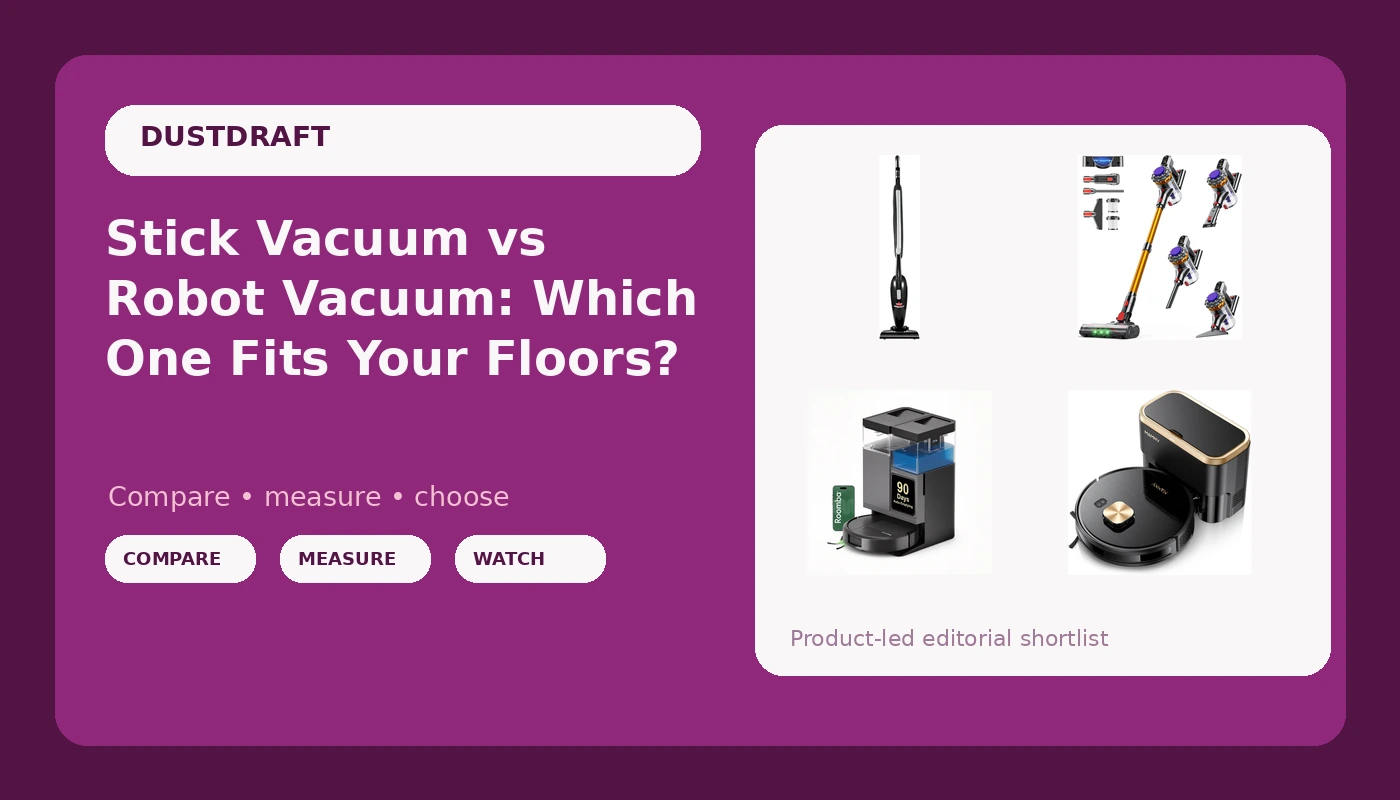
Picking between a stick vacuum and a robot vacuum is not a contest, and treating it like one is how people end up with two machines that both disappoint them. The two formats do different jobs in the same house. A cordless stick vacuum handles stairs, upholstery, car seats, and the pile of cereal that appears under the table at 7:40 in the morning. A robot vacuum and mop handles the daily grind on open floors, and a self-emptying dock is what turns that from a novelty into something you stop thinking about. Any honest stick vacuum vs robot vacuum comparison has to start there, with the shape of your home and the type of mess, not with a suction number printed on a box.
Related: How cordless vacuum battery runtime actually works →
Quick answer
They are not interchangeable, so the useful question is which job is currently costing you the most time. A cordless stick vacuum is the right tool when your mess is vertical and awkward: stairs, landings, under the kitchen table, the car, the sofa cushions. A robot vacuum and mop is the right tool when your mess is horizontal and constant: open living areas, hallways, kitchen floors, and pet hair that reappears every single day. If your home has carpeted stairs and a large main floor, one machine will not cover both well, and the self-emptying docks are the feature that makes the robot half of that pairing genuinely hands-off.
Four useful options
| Model | Best fit | What stands out |
|---|---|---|
| Cordless Vacuum Cleaner, 600W 50KPA Vacuum Cleaners for Home, 65Mins Stick Vacuum Cordless with Self-Standing, LED Display & Anti-Tangle, Lightweight Wireless Vacuum for Pet Hair/Carpets/Floors | Whole-home cordless cleaning with one hand | Self-standing design, anti-tangle brush roll, LED display |
| Bissell 2033M Featherweight Stick Lightweight Bagless Vacuum and Electric Broom with Crevice Tool for Hard Floors and Carpets, Black | Small apartments, quick tidy-ups, tight storage | Converts to an electric broom, bagless bin, crevice tool included |
| Robot Vacuum and Mop, 11500 Pa Suction, 3-in-1 Robotic Vacuum with Smart LiDAR Navigation, 90 Day Self-Emptying,160 Min Runtime,App/Alexa/Voice Control, Ideal for Pet Hair, Carpet & Hard Floor | Daily maintenance on mixed flooring | LiDAR navigation, 90-day self-emptying dock, app and voice control |
| iRobot Roomba 415X Robot Vacuum & Mop Combo, 2.3X Suction, 90 Days Self-Emptying, Multifunction Dock Self-Cleaning & Hot Dry, Smart Obstacle Avoidance, Lifting Spinning Mops, Ideal for Pet Hair | Hands-off vacuuming and mopping in one routine | Lifting spinning mops, self-cleaning and hot-dry dock, obstacle avoidance |
The everyday cordless: Cordless Vacuum Cleaner 600W 50KPA
This is the kind of cordless stick that fits a household with a mix of hard floor and low-pile carpet, where the vacuum lives in a closet and comes out several times a day. The self-standing design matters more than it sounds. A stick that falls over every time you pause to move a chair is a stick you stop reaching for. The anti-tangle claim is the one to verify against your own pets, because brush roll tangling is the single most common way a pet vacuum turns into a chore. The trade-off is familiar: cordless runtime is always longest on the lowest setting and shortest on the setting you actually want on carpet, so a 65-minute claim and a real-world number on thick pile are two different things. Keep the charger where you actually use the vacuum, not in a garage.
The lightweight budget stick: Bissell 2033M Featherweight
This is the option for a small apartment, a studio, or a second floor that only ever sees crumbs and dust bunnies. It is the lightest thing in this group and the easiest to store, and the fact that it converts into an electric broom makes it useful on bare floors and area rugs without dragging out a full-size machine. What it is not is a deep-carpet vacuum or a pet-hair workhorse. Lightweight sticks trade suction and bin capacity for exactly that lightness, and a crevice tool does not change the physics. Buy it as a supplement, or as the only vacuum in a home under about 700 square feet with mostly hard flooring. If you have three dogs and wall-to-wall carpet, this is the wrong tool and you will know it within a week.
The daily maintenance robot: Robot Vacuum and Mop, 11500 Pa
If your main floor is one open space with a mix of tile, vinyl, and low-pile carpet, this is the machine that quietly removes the daily layer of hair and grit so that your weekly clean is actually a weekly clean. LiDAR navigation is the feature worth caring about here, because it means the robot builds a map and runs in structured passes instead of bouncing off chair legs at random. The self-emptying dock is the other one: a robot you have to empty after every run is a robot you stop running. The honest caveat is that no robot in this class replaces a stick vacuum on stairs, in a car, or on a shag rug, and the 160-minute runtime figure is a manufacturer claim that assumes ideal conditions. Give it a clear path, pick up cables and socks, and it earns its floor space.
The vacuum and mop robot: iRobot Roomba 415X
This is the option for a home where mopping is the part of the routine you resent most. The lifting mops are the detail that matters in a mixed-floor house: the pads rise when the robot moves from tile onto carpet, which is what keeps you from soaking a rug. The dock handling its own mop washing and hot drying is the difference between a mop robot you use twice a week and a mop robot whose pads sit damp in a corner until they smell. The trade-offs are the usual ones for a premium combo. It costs the most of the four here, it still needs a clear floor to work around, and it does not solve stairs, upholstery, or the inside of your car. Think of it as replacing the mop bucket and the daily once-over, not the stick vacuum.
Prices and availability may change. Product images, names, and retailer links are matched to verified listings. No current price, rating, stock status, or measured result is stated here without current evidence.
Why stick vacuums and robots solve different problems
The mistake people make is comparing these two categories on a single axis. They do not share one. A cordless stick vacuum is a precision tool: you point it at a specific mess and it is gone in seconds. Its strengths are reach, control, and immediacy. You can do a staircase, a car seat, a mattress seam, and the gap between the fridge and the counter without changing a single attachment on some models. Its weaknesses are runtime, bin size, and the fact that a person has to hold it.
A robot vacuum and mop is a maintenance tool. It is not faster than you are at any single spot. It is faster than you are at doing a whole floor every single day, which is the entire point. The feature that changed this category is the self-emptying dock. Before it, a robot vacuum was a chore that moved itself around: you still had to empty the bin constantly and untangle the brush. Once the dock empties the bin, the robot becomes a background process rather than an errand.
That is why the two formats coexist in homes that take floor care seriously. The robot keeps the baseline clean. The stick handles everything the robot physically cannot reach. If you can only buy one, buy the one that matches your floor plan, not the one with the bigger number on the box.
What the spec sheet will not tell you
Suction figures printed on a listing are peak numbers, usually measured at the motor or the inlet, and they rarely describe what happens when the bin is half full, the filter is dusty, and the brush is wrapped in hair. Runtime claims are measured on the lowest power setting on a bare floor with a fresh battery. Both numbers are useful for comparing listings to each other and nearly useless for predicting your Tuesday afternoon.
Here is how to decide in practice:
- Walk your home and count the barriers: stairs, thresholds, tight chair legs, rugs with fringe, and cable clutter. Every one of those is a point for a stick vacuum and against a robot.
- Estimate how much of your floor is carpet and what pile height. Deep pile is where cordless runtime claims go to die and where robot suction matters most.
- Time your current routine. If you spend ten minutes a day on open floors, a robot pays for itself in attention. If you spend ten minutes a week on stairs, it does not.
- Check the dock situation. A self-emptying dock needs floor space and a nearby outlet, and a self-cleaning mop dock needs a water supply you are willing to manage.
- Decide who empties the bin. If the answer is "nobody, that is why we are here," prioritize self-emptying and one-handed bin release above every other feature.
Practical guidance for pet hair, stairs, and hard floors
- Judge pet-hair performance by the brush roll, not the suction number. A tangle-free or self-cleaning brush roll is the feature that decides whether you are vacuuming or performing maintenance.
- Run a cordless stick on the setting you will actually use. If the high setting gives you eight minutes, plan your cleaning in zones rather than trying to finish the house in one charge.
- Keep the robot's floor clear. Obstacle avoidance helps with furniture, but cables, socks, and pet toys are what cause most failed runs and stuck robots.
- Empty and rinse what the dock does not. Even a 90-day self-emptying dock still has a filter that needs attention, and mop pads still need to be replaced on a schedule.
- Match the machine to the stair count. If your home has a full flight or more, a cordless stick with a crevice tool and a long wand will do more for you than any robot.
Which option should you choose?
Choose the Cordless Vacuum Cleaner, 600W 50KPA when your cleaning is spread across stairs, furniture, cars, and a mix of hard floor and low-pile carpet, and you want one cordless tool that stands up on its own and claims a tangle-resistant brush roll.
Choose the Bissell 2033M Featherweight Stick when you live in a small space with mostly hard flooring, you want something light enough to grab without thinking, and you need a crevice tool more than you need maximum suction.
Choose the Robot Vacuum and Mop, 11500 Pa when your main floor is open, your daily mess is pet hair and kitchen grit, and you want mapped navigation plus a dock that holds debris for up to 90 days.
Choose the iRobot Roomba 415X when mopping is the job you want to stop doing, you have a mix of hard floor and carpet, and a dock that washes and hot-dries its own mop pads is worth the premium to you.
One caveat before you buy: all four listings here rely on manufacturer specifications, including suction figures, runtime estimates, and dock capacity ratings. Those are the claims the brands publish. Verify them against the current listing and your own floor plan rather than assuming they translate directly to your home.
The bottom line
A stick vacuum and a robot vacuum are not rivals. The stick is the tool you reach for when the mess is specific, vertical, or urgent, and it stays useful as long as its brush roll does not tangle and its bin empties with one hand. The robot is the tool that keeps an open floor at a baseline level of clean without you thinking about it, and the self-emptying dock is what makes that real. If you have to pick one, pick based on stairs and carpet: more stairs means a cordless stick, more open hard floor means a robot. If you can eventually own both, the combination covers far more of a real home than either one manages alone.