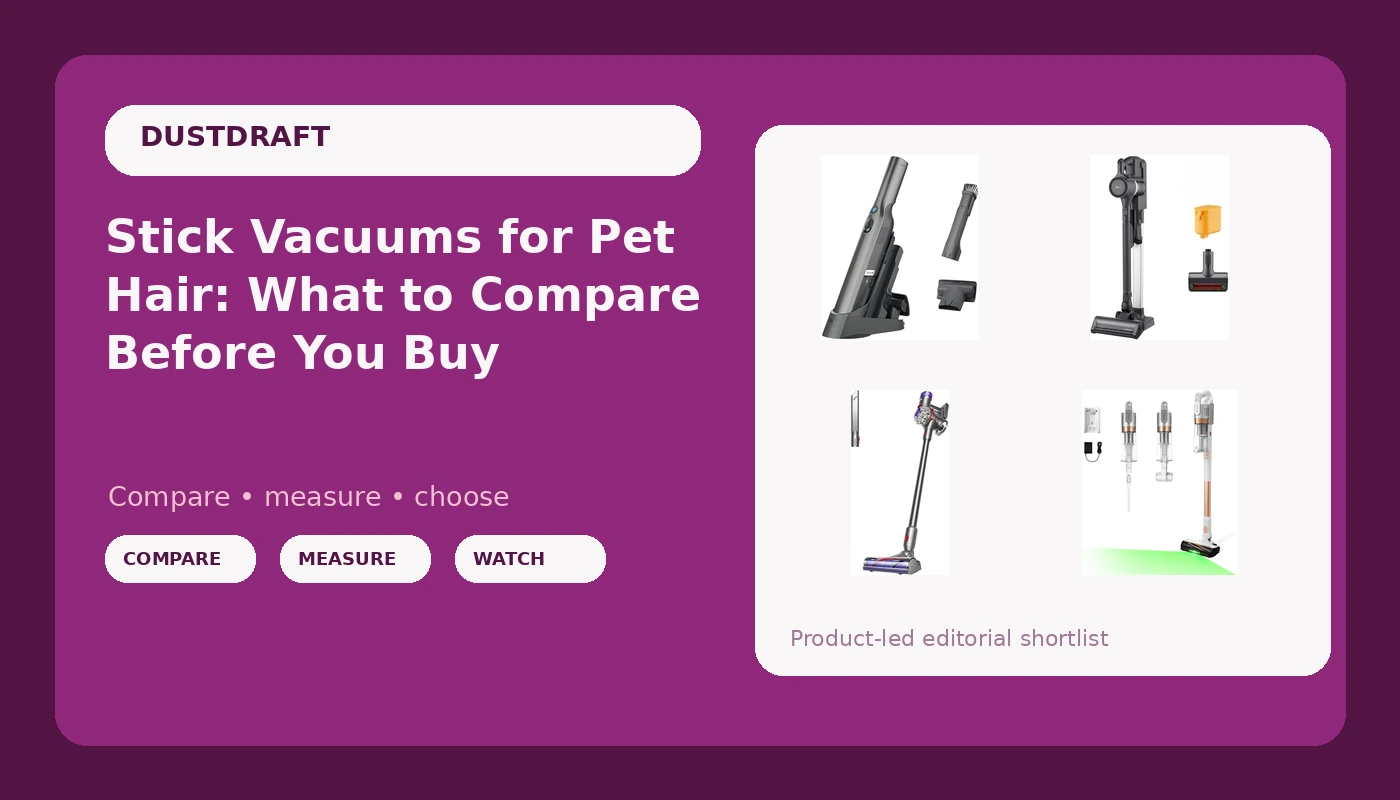
If you share a home with a shedding dog or cat, you already know the problem. The floor looks clean, then you run a hand over the rug and come up with a fistful of fur. Stick vacuums for pet hair promise to fix that in one pass, but the category is crowded and the spec sheets are written to sell rather than to inform. Runtime figures are measured under ideal conditions. Suction numbers come from a lab bench, not your hallway. This explainer walks through four cordless options, what each one is actually built for, and which details matter when pet hair, stairs, and a half-full bin are part of the job.
Related: How Long Do Cordless Vacuum Batteries Actually Last? →
Quick answer
There is no single cordless vacuum that suits every home, so match the tool to the job instead of chasing a spec sheet. A pet-hair-focused cordless stick covers open floors and rugs, a renewed flagship model suits large homes and long sessions, a well-established platform keeps parts and accessories easy to find, and a compact handheld handles stairs, cars, and crevices that a full-size stick cannot reach. Runtime numbers printed on a box are a ceiling, not a promise, because they are measured under specific conditions that rarely match a real living room.
Four useful options
| Model | Best fit | What stands out |
|---|---|---|
| Levoit VortexIQ Cordless Vacuum Cleaner for Pet Hair, 50-Min Runtime | Pet-hair homes watching the budget | Marketed specifically for pet hair, with a listed 50 minute runtime |
| LG CordZero Kompressor Cordless Stick Vacuum A941KTMP (Renewed) | Large homes and long cleaning sessions | Renewed flagship stick with the Kompressor bin design named in the model |
| Dyson V8 Cordless Vacuum | Buyers who want a familiar, widely supported platform | Long-running cordless line, so tools and spares are easy to source |
| Shark WV201 WANDVAC Handheld Vacuum | Stairs, cars, and quick pickups | Listed at 1.4 pounds with a charging dock, single-touch empty, and detachable dust cup |
The pet-hair pick: Levoit VortexIQ Cordless Vacuum Cleaner for Pet Hair, 50-Min Runtime
The trade-off here is straightforward. A pet-hair label tells you what the vacuum is designed to do, but it does not tell you how the brush roll behaves on the second pass or how long the battery lasts on a thick rug. Those are the two questions that decide whether a cordless vacuum becomes a daily tool or a closet resident. If you have one shedding animal and mostly hard floors with a couple of area rugs, this is the class of vacuum that makes sense. If you have three animals and wall-to-wall carpet, read the runtime section below before you commit.
The large-home pick: LG CordZero Kompressor Cordless Stick Vacuum A941KTMP (Renewed)
Renewed is not a dirty word in vacuums. It usually means the unit has been inspected, cleaned, and brought back to working condition, which is why the price is typically well below new stock. The trade-off is uncertainty about the specific unit you receive, so check what the seller includes: charger, dock, wand, and tools. A stick vacuum missing its wand is a very expensive handheld. For a big house, the deciding factor is rarely peak suction. It is whether you can finish the upstairs hallway without watching the battery indicator drop.
The established-platform pick: Dyson V8 Cordless Vacuum
The argument for a familiar platform is boring and correct: support. Cordless vacuums fail in predictable places, and the two most common are the battery and the brush bar. On a model that has sold for years, both are replaceable without guesswork. The argument against is that a well-known name is not automatically the right fit for your floor type. A cordless stick is a compromise tool by design. It trades raw deep-cleaning power for speed and reach, and on thick carpet the compromise shows up as extra passes.
The stairs-and-cars pick: Shark WV201 WANDVAC Handheld Vacuum
Most people who own a stick vacuum eventually buy something like this anyway, usually after the first time they try to vacuum a car with a full-size wand. A handheld is not a replacement for a stick. It has a smaller bin, less reach, and it will not clean a whole living room without frequent emptying. What it does well is the work a stick is bad at: stair treads, the gap beside the fridge, the footwell of a car, and the crumb explosion under a high chair.
Prices and availability may change. Check the product page for current details, included accessories, and condition notes before ordering.
What runtime numbers actually measure
A runtime figure is a lab result, not a household fact. Manufacturers typically measure it with a fresh battery, on the lowest power setting, on a bare floor, with no powered attachment running and an empty bin. Every one of those conditions is favorable, and every one of them changes in a real home.
Three things shorten runtime in practice. The first is power mode: the higher setting that actually lifts embedded pet hair can cut usable time substantially compared with the low setting the claim was measured on. The second is surface resistance, because a powered brush roll working against thick pile draws more current than a bare floor. The third is battery age, since lithium cells lose capacity over hundreds of charge cycles, and a vacuum that ran twenty minutes when new will not run twenty minutes in year three.
The practical takeaway is to size the runtime to the job rather than to the room. If your longest uninterrupted cleaning stretch is a ten minute hallway and kitchen, a mid-range figure is plenty. If you clean an entire floor in one pass, runtime becomes the single most important number on the page, and a model with a removable, swappable battery changes the math entirely because you can keep a charged spare on the dock.
Bin design, brush rolls, and the pet-hair problem
Pet hair is a mechanical problem before it is a suction problem. It wraps. It mats. It forms a felt-like sleeve around a spinning brush bar, and once that sleeve is thick enough, the brush stops grabbing and starts polishing. This is why a self-cleaning brush roll is the single most useful feature on a pet vacuum: the brush shreds hair off itself as it spins instead of collecting it in a ring that you have to cut away with scissors.
Bin design is the second half of the story. Cyclone separators spin dust out of the airflow so the filter stays clear, and when they work well, suction holds steady as the bin fills rather than fading after the first few minutes. When they work badly, you get a vacuum that feels strong on an empty bin and weak on a half-full one. Compaction systems, the idea behind the Kompressor name, attack a related problem: pet hair is bulky, so a bin that compresses debris lets you clean longer between empties.
Then there is emptying, which is where good vacuums and bad vacuums separate. A bin you can release and dump over a trash can with one hand gets emptied after every use. A bin that requires two hands, a twist, and a prayer gets emptied late, and a full bin is a performance problem long before it is a convenience problem.
- Measure your longest uninterrupted cleaning stretch, then compare it against the runtime figure rather than against the room count.
- Identify your worst surface: thick carpet, area rugs over hard floor, or bare floors with pet hair tumbleweeds.
- Check whether the brush roll is designed to resist hair wrap, since that determines how much maintenance the vacuum demands.
- Confirm the bin can be emptied one-handed and that the dust cup detaches without tools.
- Decide whether you need one vacuum or two, because a handheld for stairs and cars often beats a bigger stick used badly.
Practical guidance before you buy
- Read the runtime claim as a ceiling measured on low power, then assume real sessions on carpet will be shorter.
- Look for a removable battery if you clean more than one floor, because a charged spare removes charging time from the equation entirely.
- Weigh the vacuum in your hand, not on the spec sheet, since a stick you dread carrying up stairs stops getting used.
- Check what actually ships in the box: wand, dock, crevice tool, and upholstery brush are frequently configuration-specific.
- Treat renewed listings as a value play with a homework requirement, and read the condition notes and included parts carefully.
- Match filtration to your household, because allergies and pet dander make filter design more important than a suction number.
Which option should you choose?
Choose the Levoit VortexIQ Cordless Vacuum Cleaner for Pet Hair, 50-Min Runtime when pet hair is the main event and you want a cordless stick designed around that job. Choose the LG CordZero Kompressor Cordless Stick Vacuum A941KTMP (Renewed) when you clean a large home in long sessions and want flagship features at a renewed price. Choose the Dyson V8 Cordless Vacuum when long-term parts availability matters more to you than a feature list. Choose the Shark WV201 WANDVAC Handheld Vacuum when stairs, cars, and crevices are the jobs that keep getting skipped.
One caveat applies to all four. Nothing here substitutes for measuring your own space. The runtime on the box, the weight on the listing, and the bin size in the spec table are all inputs, not answers, and the only test that counts is whether the vacuum gets used on a Tuesday when you are tired and the floor is covered in fur.
The bottom line
The right cordless vacuum for a pet home is the one that still has suction when the bin is half full, a brush roll that does not need monthly surgery, and a bin you can empty with one hand. Those three things matter more than any single number printed on a box. A pet-hair-focused stick handles the everyday floors, a renewed flagship covers big homes and long sessions, a familiar platform keeps repairs simple, and a light handheld reaches the stairs and car seats that everything else misses. Pick the combination that fits how you actually clean, and verify the current details on the product page before you order.