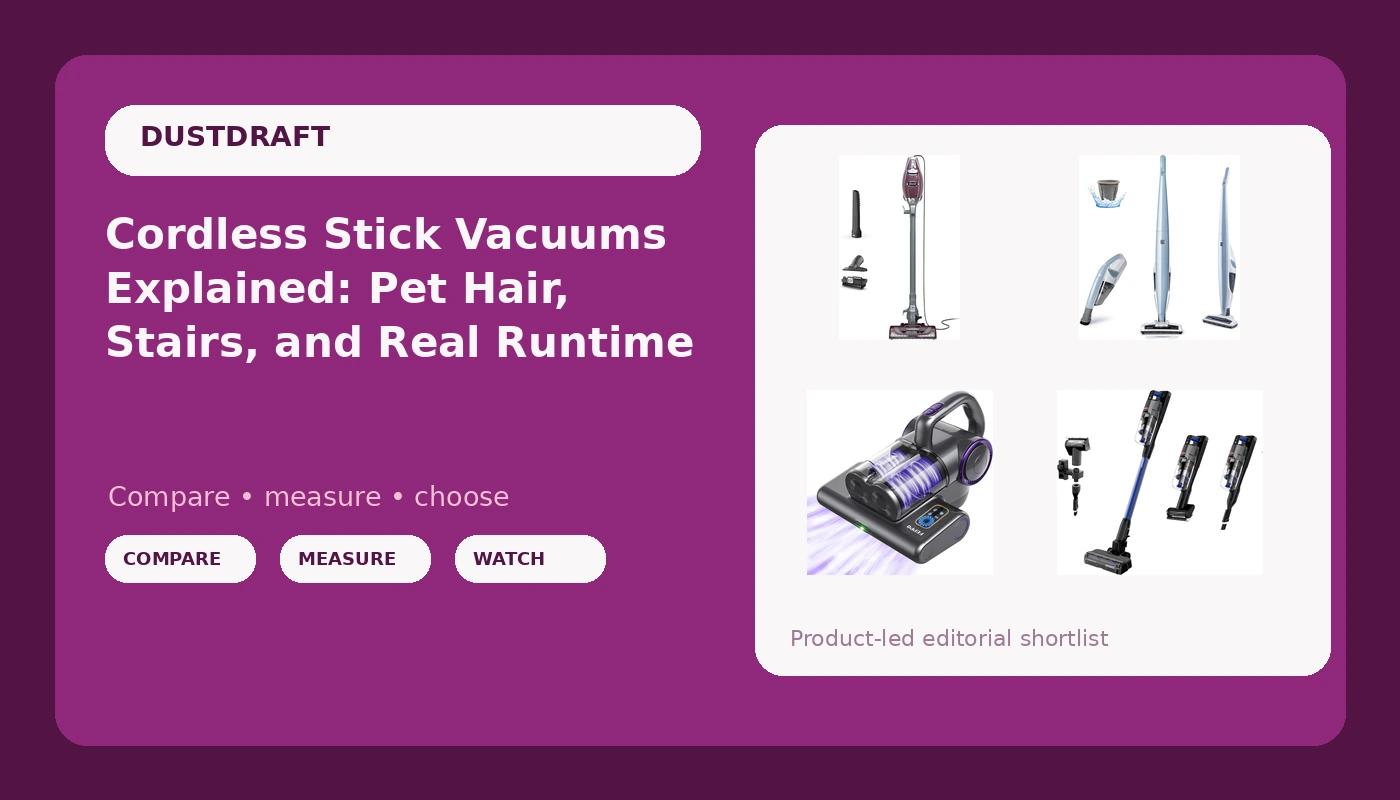
Buying a cordless stick vacuum for pet hair is mostly an exercise in ignoring the loudest numbers on the box. Suction gets quoted at the motor, runtime gets quoted on a bare floor with a fresh battery, and neither figure tells you what happens on the second pass across carpet that a husky has been sleeping on all week. The question that actually decides whether a vacuum earns its closet space is simpler: does it still pull when the bin is half full, and can you empty that bin one-handed? This explainer goes through what the specifications on four current models really describe, which jobs each one is built for, and how to match the tool to your floors before you spend anything.
Related: Why Pet Hair Kills Brush Rolls, and How to Stop It →
Quick answer
Match the vacuum to the surface and the mess, not to the largest number on the label. A corded stick is the right answer for heavy pet hair on carpet, because runtime never runs out. A low-voltage cordless is the right answer for a small apartment with hard floors and light debris. A dedicated mattress vacuum is the right answer for beds, sofas, and upholstery, which floor vacuums handle poorly. A self-standing cordless is the right answer when one tool has to cover quick passes on floors, stairs, and under furniture. Each of the four options below is built for a different job, and none of them is the right answer for every home.
Four useful options
| Model | Best fit | What stands out |
|---|---|---|
| Shark Rocket Pet Plus Corded Stick Vacuum, XL Cup, Bordeaux/Silver, HV322 | Carpeted homes with heavy shedders | Corded stick format with an extra-large cup |
| Kenmore DS1020 16V Cordless Stick Vacuum Lightweight 2-in-1 Handheld | Small spaces with hard floors | 16V cordless system that converts to a handheld |
| FEPPO Mattress Vacuum Cleaner, 16Kpa Bed Vacuum with 253.7nm UV-C Light | Beds, sofas, and upholstery | 16 kPa bed vacuum with a 253.7 nm UV-C head |
| Bissell PowerClean FurFinder 200W Self-Standing Cordless Vacuum, 4052 | One tool for floors and stairs | Self-standing cordless body with 200W motor rating |
The corded pet-hair workhorse: Shark Rocket Pet Plus Corded Stick Vacuum, XL Cup, Bordeaux/Silver, HV322
The cord is the entire argument here, and it cuts both ways. A corded stick never loses suction because a battery is fading, and it never needs a charging dock, which makes it the sensible pick for a whole-house clean or a long pet-hair session on carpet. What you give up is the freedom to walk anywhere without thinking about an outlet. In practice that means planning the clean around where the receptacles are, and accepting that stairs get vacuumed with the cord trailing behind you. The XL cup matters more than it sounds. A bin that fills in one room forces a stop, and stops are what make a stick vacuum feel like work. If your home is mostly carpet and mostly shedding animals, corded is the honest choice.
The lightweight daily driver: Kenmore DS1020 16V Cordless Stick Vacuum Lightweight 2-in-1 Handheld
The 16-volt rating is the thing to understand before you buy. It sits below the voltage of premium cordless machines, so this is not a tool for deep-cleaning wall-to-wall carpet, and no amount of marketing changes that. What it is good at is the quick pass: crumbs under a high chair, litter tracked out of a bathroom, hair on a hard floor, and the crevice work a full-size vacuum is awkward for. The 2-in-1 conversion is the real feature. Pull the stick off and you have a handheld for stairs, car seats, and the gap behind the couch. For a one-bedroom apartment with hard floors, that combination covers almost everything. For a house with three carpeted bedrooms and a shedding dog, it will leave you wanting more.
The mattress and upholstery specialist: FEPPO Mattress Vacuum Cleaner, 16Kpa Bed Vacuum with 253.7nm UV-C Light
A mattress vacuum is a different category of tool, and it should not be judged as a floor vacuum. The 16 kPa figure describes suction at the cleaning head, and the 253.7 nm figure describes the wavelength of the UV-C light in that head. Two honest caveats come with it. First, UV-C does what it does only where the light lands and only for as long as it dwells there, so a slow pass covers more surface than a fast one. Second, nothing about a UV-C head replaces washing bedding at a temperature your fabric can tolerate. What a bed vacuum genuinely solves is the mechanical part: lifting dust, skin cells, and pet dander out of a mattress surface that a floor vacuum cannot reach. If allergies or a pet that sleeps on the bed are why you are shopping, this belongs in the plan alongside a floor vacuum, not instead of one.
The self-standing all-rounder: Bissell PowerClean FurFinder 200W Self-Standing Cordless Vacuum, 4052
Self-standing sounds like a small detail until you have owned a stick vacuum that does not do it. Being able to release the handle mid-clean, without leaning the machine against a wall or laying it on the floor, is often the difference between a tool you reach for and one you avoid. The 200W figure is a motor rating, not a promise about suction at the floor head, and it should be read that way. The FurFinder name is the relevant signal if shedding is your problem. Cordless does mean battery: runtime drops as the battery ages, and thick carpet draws more than hard floor does. The honest way to think about it is that this is the option for someone who wants one machine for quick daily passes on carpet, hard floor, and stairs, in a home where pet hair is constant rather than seasonal.
Prices and availability may change. Product images, names, and retailer links are matched to verified listings. No current price, rating, stock status, or measured result is stated here without current evidence.
What cordless actually buys you, and what it costs
Voltage and wattage describe the motor, not the cleaning. A 16V machine and a 200W machine are not directly comparable, because one figure is a battery system voltage and the other is a motor power rating. What you feel on the floor is a combination of airflow, agitation from the brush roll, and how well the bin separates dirt from air as it fills. That last part is where cheaper cordless vacuums lose their reputation: as the bin loads up, airflow drops, and the machine that felt strong on an empty bin starts leaving grit behind. That is why the second pass matters more than the first.
Runtime is the other place where the marketing number and the real number part ways. A quoted runtime is typically measured on the lowest power setting, on a bare floor, with a new battery and an empty bin. Thick carpet, a brush roll working hard, and a half-full bin all pull that figure down. Cold weather pulls it down further, which is not a small consideration in a place like Denver. If your clean routinely runs longer than the machine does, the honest fix is either a corded model or a system with a spare battery.
Why brush roll design decides the pet-hair question
The brush roll is where pet hair is won or lost. Hair wraps around a spinning brush, and once it wraps, two things happen: the brush stops agitating the carpet effectively, and the airflow path narrows. A vacuum with a tangled brush roll can still sound like it is working while it does very little. This is why tangle-resistant and self-cleaning brush roll designs matter more in a pet home than a slightly higher suction number. The mechanism varies by brand, but the goal is the same: keep hair moving into the bin instead of winding around the axle.
Filtration is the second half of the pet equation. A vacuum that captures hair but blows fine dander back into the room has not solved the problem for anyone with allergies. Look for a sealed system and a filter you can remove, rinse, and replace without a manual. On the mattress side, the same logic applies in miniature: a bed vacuum has to agitate the surface to lift dander out of the fabric, and the UV-C light is a secondary measure rather than the main event.
- Decide whether you need cordless freedom or uninterrupted runtime, because you cannot have both at once.
- Measure the longest single stretch you clean without passing an outlet.
- Check whether the brush roll is designed to resist hair wrap, especially with a double-coated dog in the house.
- Confirm the bin can be emptied with one hand and without removing the whole cleaning head.
- Check that filters are user-serviceable, then budget for replacements.
Practical guidance for real homes
- Keep the vacuum where you use it most, because a machine stored in a basement gets used once a month.
- Empty the bin after every pet-hair session instead of waiting for the fill line, since airflow drops as the bin loads.
- Do a slow second pass on carpet rather than a fast first pass, because agitation needs contact time.
- Rinse and dry foam and fabric filters on a schedule, and replace them when airflow stays weak even after cleaning.
- For stairs, pick a model you can carry in one hand with the other hand free.
Which option should you choose?
Choose the Shark Rocket Pet Plus Corded Stick Vacuum, XL Cup, Bordeaux/Silver, HV322 when your floors are mostly carpet, your pets shed heavily, and you would rather never think about a battery again. Choose the Kenmore DS1020 16V Cordless Stick Vacuum Lightweight 2-in-1 Handheld when you live in a smaller space with hard floors and want one lightweight tool that also works as a handheld. Choose the FEPPO Mattress Vacuum Cleaner, 16Kpa Bed Vacuum with 253.7nm UV-C Light when the surfaces you are worried about are beds, sofas, and upholstery. Choose the Bissell PowerClean FurFinder 200W Self-Standing Cordless Vacuum, 4052 when you want a single cordless machine that stands on its own and covers quick passes on carpet, hard floor, and stairs.
One caveat applies to all four. The specifications here come from the product listings, and a listing cannot tell you how a machine behaves in your home after six months. Battery capacity declines with age, filters load up, and brush rolls wear. Buy for the job you do weekly, not for the deep clean you do twice a year.
The bottom line
Stick vacuum shopping gets easier once you stop comparing suction numbers and start comparing jobs. Corded machines trade freedom for unlimited runtime, low-voltage cordless machines trade power for convenience, mattress vacuums solve a surface that floor vacuums cannot, and self-standing cordless models solve the small daily friction that decides whether a vacuum gets used at all. Pick the one that matches the floors you actually have, check the current Amazon price on the listing, and expect the machine to be judged on its second pass rather than its spec sheet.