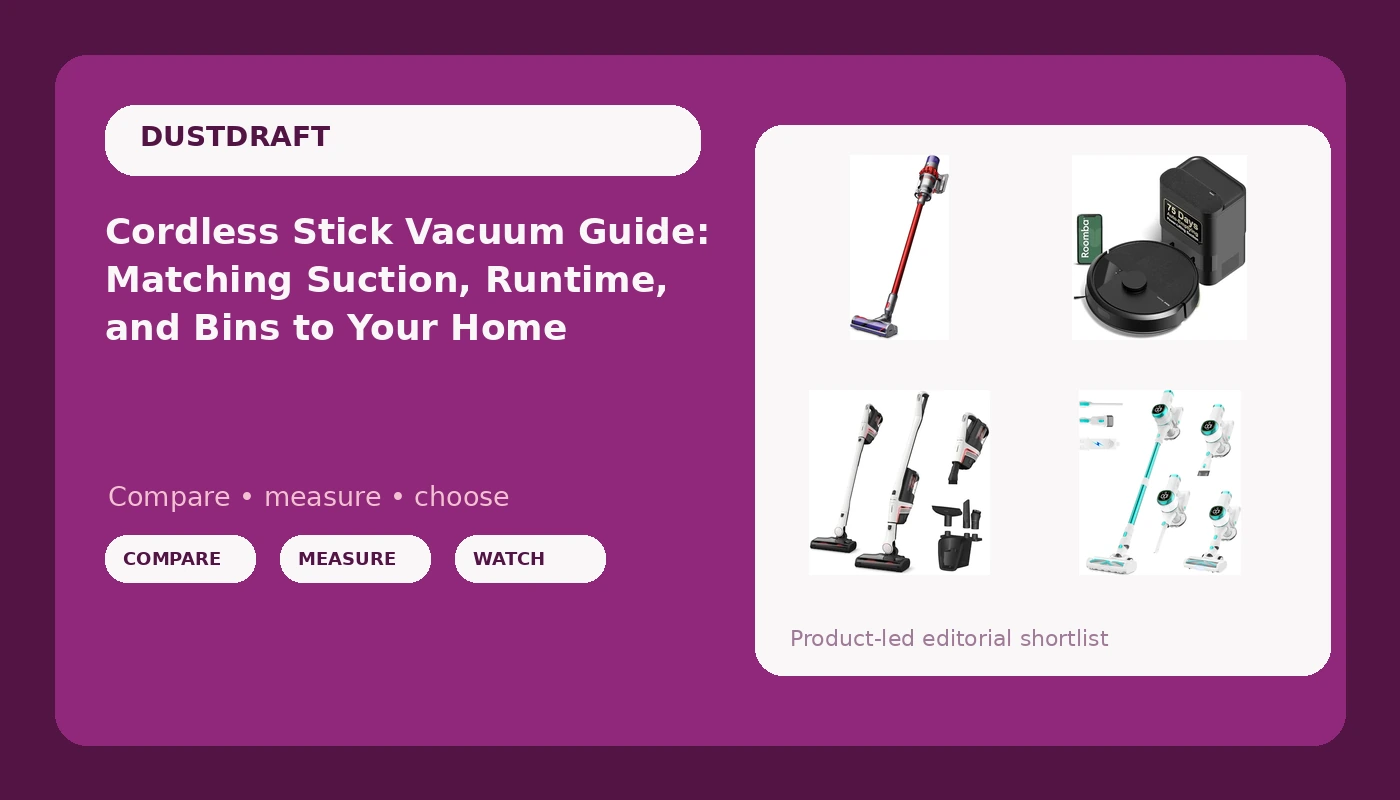
Buying a cordless stick vacuum in 2026 means sorting through spec-sheet numbers that rarely survive contact with a real hallway. Suction gets quoted in pascals, run time gets quoted from a bare floor with a fresh battery, and almost nothing on the box tells you whether the bin will still pull dirt out of carpet once it is half full. The four machines below sit at genuinely different points on that spectrum: a light and inexpensive cordless stick vacuum, a long-established cordless platform, a modular premium stick, and a robot that empties its own bin. This explainer walks through what each one is for, what its product listing actually says about it, and how to match a format to your floors.
Related: How to Keep a Stick Vacuum Alive Through Pet Season →
Quick answer
Start with your floors and your storage, not the suction number. For a light, low-cost cordless stick that handles hard floor and carpet and hangs on a wall dock, the Tikom V500 is the entry point. For a cordless stick from a brand with a long-running platform and a motorized Motorhead cleaner head, the Dyson Cyclone V10 Motorhead is the familiar option. For a bagless, battery-powered stick that can be reconfigured, the Miele Triflex HX1 is the modular choice. And if you would rather not push anything at all, the iRobot Roomba 105 with its AutoEmpty dock is the hands-off option, though it is a robot vacuum rather than a stick, which changes what it can and cannot do.
Four useful options
| Model | Best fit | What stands out |
|---|---|---|
| Tikom V500 Cordless Vacuum Cleaner | Lightweight everyday pickup on hard floor and carpet | 40000Pa/450W rating, anti-tangle brush, LED touch screen, charging wall dock |
| Dyson Cyclone V10 Motorhead | Households that want a familiar cordless stick platform | Cyclone V10 cordless stick design with a Motorhead cleaner head |
| Miele Triflex HX1 | Buyers who want a premium stick that changes shape | Bagless, battery-powered stick in a reconfigurable Triflex design |
| iRobot Roomba 105 | Daily floor maintenance you do not want to think about | AutoEmpty dock, LiDAR navigation, multi-surface cleaning, neat-row pattern |
The lightweight pick: Tikom V500 Cordless Vacuum Cleaner
The V500 is a reminder that a cordless stick is a format decision before it is a spec decision. Light weight is not a marketing flourish here, it is the whole reason a stick vacuum gets used instead of a canister: you grab it for a two-minute pass in the kitchen, not a scheduled whole-house session. The anti-tangle brush claim is the one worth paying attention to if you live with a shedding animal, because a brush roll wrapped in hair stops picking up long before the battery dies. The trade-off is the usual one for a light, inexpensive cordless. Plan on short, frequent passes rather than one long session, and expect to empty the bin more often than you would with a larger machine. The listing leads with suction and weight rather than run time, so treat the pascals figure as one input among several, not the answer.
The established cordless platform: Dyson Cyclone V10 Motorhead
Generation names matter in this lineup, and that is the main thing to understand before you buy. Dyson has shipped several cordless generations, and the model name is what tells you which platform you are actually getting. Two sticks that look nearly identical in photos can sit several generations apart, which is why comparing a single suction figure across brands tells you less than comparing bin design, brush design, and how the tool stores. The cyclone system is the part worth understanding: it separates dirt from the airflow before the air reaches the filter, so a well-designed cyclone stack keeps airflow steadier as the bin fills. That is the difference between a vacuum that cleans the first pass and one that needs a second pass over the same square of carpet. As a trade-off, a well-known platform means you are paying for the name as well as the hardware, and older generations stay on shelves long after newer ones arrive. Check that the listing matches the generation you intend to buy.
The modular premium stick: Miele Triflex HX1
The interesting question with the HX1 is not suction, it is shape. Most cordless sticks are one fixed arrangement: handle up, head down, hang it on a wall. A reconfigurable design lets you move the heavy part of the machine closer to your hand, or shorten the whole thing for a car interior or a stairwell, without buying a second vacuum. For a house with stairs, that flexibility is the feature that gets used. The trade-offs are the ones that come with bagless premium sticks. You handle the dust yourself every time you empty the bin, you are responsible for keeping the filter and bin seals clean, and a battery-powered stick always needs a charging spot that is actually convenient. If the charger lives in a closet behind the coats, the vacuum will not get used. Decide where it lives before you decide whether to buy it.
The hands-off option: iRobot Roomba 105
The self-emptying dock changes the maintenance rhythm more than any suction number can. With a standard stick, you empty a small bin every session or two. With an AutoEmpty base, the robot dumps its bin into a larger container in the dock, and the listing puts that interval at 75 days. That is the difference between a chore you do weekly and a chore you do a few times a year. The limits are structural, not fixable. A robot cannot climb stairs, cannot clean a couch, and cannot reach the gap beside the fridge unless you clear the floor first. LiDAR navigation helps it map and cover a room in orderly rows rather than bouncing randomly, but it still needs a floor you have picked up. The realistic setup in a home with both pets and stairs is a robot for daily maintenance on the main level and a stick for everything the robot cannot reach.
Prices and availability may change. Product images, names, and retailer links are matched to verified listings. No current price, rating, stock status, or measured result is stated here without current evidence.
What the numbers on the box actually measure
A suction rating in pascals is a pressure measurement, usually taken at the inlet with a clean filter and an empty bin. That is a useful number for comparing two machines in the same lab conditions, and a nearly useless one for predicting what happens in your hallway on the tenth minute of a carpet pass. The rating does not describe how well the machine maintains airflow as the bin loads up, which is where cyclone design and filter condition start to matter more than the peak figure.
A wattage rating is input power, not cleaning power. A motor that draws more watts is not automatically moving more air; the impeller design, the seals around the bin, and the condition of the filter all sit between the motor and the floor. Two vacuums with the same wattage can behave very differently on medium-pile carpet.
Run time claims deserve the same suspicion. The headline number is normally measured on the lowest setting, often with a non-motorized tool attached, on a bare floor with a fresh battery. Add a motorized brush roll and a carpet, and usable minutes drop. If you have a large home and one vacuum, this is the number that decides whether you finish the job, which is why it pays to look for a machine with a swappable or extended battery arrangement if run time is your constraint.
Bin volume is the quiet spec. A small bin on thick carpet means stopping to empty before the job is done, and every stop is a chance to not restart.
Brush rolls, bins, and the parts that decide whether you keep using it
The parts that determine whether a vacuum gets used twice a week or twice a year are the boring ones: the brush roll, the bin latch, and the dock.
An anti-tangle brush roll is the single most valuable feature in a home with long hair or a shedding dog. The mechanism varies, from combs that strip hair off the bristles to rubber vanes that resist wrapping in the first place, but the outcome is the same: no monthly session with scissors. The V500 listing claims anti-tangle, and that is the claim to hold a cordless stick to.
Bin emptying is the second one. A bin with a single latch you can trip over a trash can with one hand is a bin you will empty before it is packed solid. A bin that needs both hands and a twist is a bin that gets overfilled, which is how filters clog and suction complaints start.
Docking is the third. The V500 includes a charging wall dock, the Roomba 105 includes an AutoEmpty base, and the Dyson and Miele sticks need a home you choose for them. Where the vacuum charges is where it gets used.
- List your floor types and roughly what share of the house each one covers, since carpet and hard floor ask different things of a brush roll.
- Count the hair sources: pets, long hair, kids, or all three. That count, not the square footage, decides how much anti-tangle design matters.
- Decide the job. Daily maintenance on open floor, weekly deep passes on carpet, or above-floor work on stairs, couches, and cars.
- Measure your storage. A wall dock, a robot base, and a stick leaning in a closet take up different amounts of space, and the wrong spot means the machine never leaves it.
- Decide who does the work and how many hands it takes. A vacuum that needs two hands and a squat is one that gets skipped.
Practical guidance for living with a cordless vacuum
- Empty the bin at half full on carpet rather than waiting for the fill line. Airflow is what picks up dirt, and a loaded bin chokes it.
- Clean or rinse the filter on the schedule the manual gives you. Most "it lost suction" complaints are a filter problem, not a motor problem.
- Cut wrapped hair off the brush roll instead of pulling it. Pulling damages bristles and bearings, and the tangle comes back faster.
- Use the lowest mode that picks up and save the maximum setting for a second pass. Constant max mode is how a battery quits mid-room.
- Park the machine on its dock every time, including the robot. A vacuum that is charged and reachable is the only one that gets used.
Which option should you choose?
Choose the Tikom V500 Cordless Vacuum Cleaner when you want the lightest option, a low entry point, and a cordless stick that handles hard floor and carpet with an anti-tangle brush and a wall dock. Choose the Dyson Cyclone V10 Motorhead when you want a cordless stick from a long-running platform and a motorized Motorhead head, and you are comfortable checking which generation the listing describes. Choose the Miele Triflex HX1 when a reconfigurable, bagless premium stick fits your stairs and your storage, and you do not mind handling the dust yourself. Choose the iRobot Roomba 105 when the daily floor pass is the job you want off your list entirely and you have open, uncluttered floors for it to navigate.
The caveat that applies to all four: a product listing describes features, not results in your house. Suction ratings, run times, and self-emptying intervals come from the manufacturer, and they assume clean filters, empty bins, and ideal conditions. Verify current details, prices, and availability on the listing before you buy, and treat any single number as one input in the decision rather than the decision itself.
The bottom line
The right cordless setup is usually a combination, not a single machine. A robot with a self-emptying dock like the Roomba 105 covers the daily pass on open floors so you stop thinking about it. A stick vacuum covers the stairs, the couch, the car, and the spill you notice on the way out the door. Within the stick category, the Tikom V500 is the light, low-cost route with an anti-tangle brush and a wall dock, the Dyson Cyclone V10 Motorhead is the familiar platform with a motorized head, and the Miele Triflex HX1 is the modular premium option that changes shape to fit the job. Pick the format first, the brush roll second, and the suction number last.