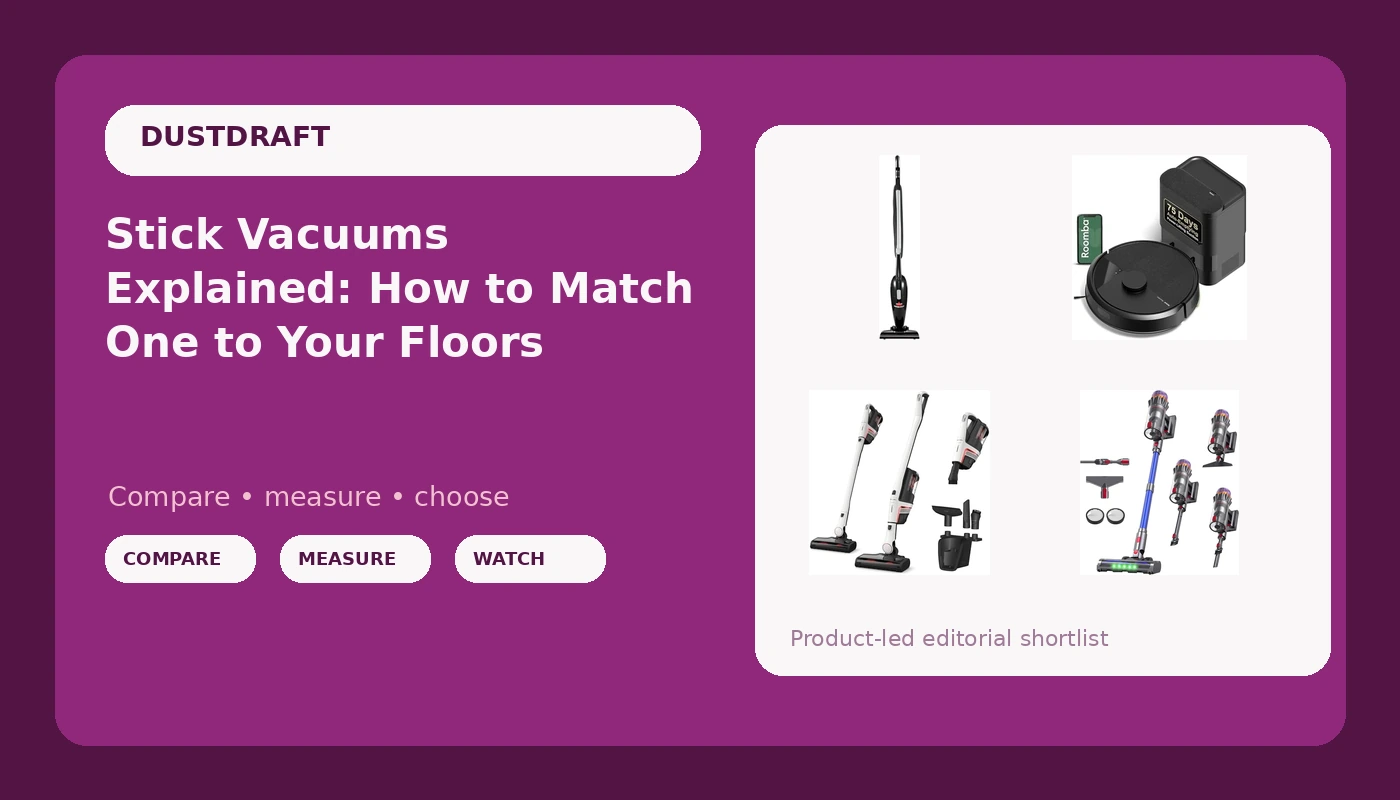
Stick vacuums are the fastest way to keep a floor presentable between deep cleans, and they are also the category where the spec sheet runs furthest ahead of the experience. A listing will happily tell you a motor is rated at 600W or that suction reaches 55 kPa, but it will not tell you whether that suction holds when the bin is half full, whether the brush roll wraps itself in pet hair after one pass down a hallway, or whether you can empty the bin one-handed while the phone is ringing. This explainer covers the four models on this page, what their published numbers actually describe, and how to match a vacuum to your floors, your pets, and the amount of effort you are willing to spend on a Tuesday afternoon.
Related: Stick Vacuum Runtime Claims: What 60 Minutes Really Means →
Quick answer
Match the tool to the job you do most often. If you want the most aggressive published specs for the money, the Cordless Stick Vacuum Cleaner lists the highest motor, suction, and runtime figures in this group. If you want something light enough to grab for a two-minute kitchen sweep, the Bissell Featherweight is the simplest option here. If you would rather the floor be maintained without you pushing anything at all, the Roomba 105 with its AutoEmpty Dock is the hands-off choice. If you want a battery-powered bagless stick from an established appliance brand with a convertible body, the Miele Triflex HX1 is the premium pick. None of these is the quietest or the fastest in any absolute sense. They solve four different problems.
Four useful options
| Model | Best fit | What stands out |
|---|---|---|
| Cordless Stick Vacuum Cleaner, 600W 55Kpa 70Mins for Home, Pet Hair, Carpet | Budget-conscious homes with pets and carpet | Published ratings of a 600W motor, 55 kPa suction, and up to 70 minutes of runtime |
| Bissell 2033M Featherweight Stick Lightweight Bagless Vacuum and Electric Broom with Crevice Tool for Hard Floors and Carpets, Black | Quick passes on hard floors and low-pile carpet | Lightweight bagless design with a crevice tool included |
| iRobot Roomba 105 Vac Robot Vacuum with AutoEmpty Dock | Hands-off daily upkeep | LiDAR navigation plus a dock the maker states self-empties for up to 75 days |
| Miele Triflex HX1 Battery Powered Bagless Stick Vacuum, Lotus White | Buyers who want a premium bagless stick | Battery-powered bagless stick with Miele's convertible Triflex body |
The spec-sheet pick: Cordless Stick Vacuum Cleaner, 600W 55Kpa 70Mins for Home, Pet Hair, Carpet
On paper this is the most powerful vacuum in the group, and "on paper" is the phrase to hold onto. A 600W motor rating describes electrical draw, not cleaning force. Suction figures like 55 kPa are usually peak measurements taken at the inlet with an empty bin and a clean filter, and they fall as the bin fills and the filter loads. The 70 minute runtime is a ceiling, typically measured on the lowest power setting over a bare floor. Carpet and higher power settings cut that number substantially. What the listing does establish is intent: it is built and marketed for homes with pets and carpet, which is exactly where a stick vacuum has to work hardest. Treat the numbers as a starting point, then weigh bin design, brush roll, and weight as the deciding factors.
The featherweight pick: Bissell 2033M Featherweight Stick Lightweight Bagless Vacuum and Electric Broom with Crevice Tool for Hard Floors and Carpets, Black
The argument for a tool like this is not power, it is proximity. The vacuum that gets used is the one already standing where the crumbs are. A light body gets picked up for a thirty second job, and a heavy one gets postponed until the weekend. The trade-offs are real, though: a lightweight design usually means a smaller bin, gentler agitation, and a shorter working session before you need to empty it. For a quick pass on hard floors, kitchen debris, and the strip of floor around a litter box, that trade is fine. For a whole-house carpet clean with two shedding dogs, it is the wrong tool. Know which job you are buying for before you compare price tags.
The hands-off pick: iRobot Roomba 105 Vac Robot Vacuum with AutoEmpty Dock
This is not a stick vacuum and it is not trying to be one. A robot handles the daily maintenance layer: the dust, the crumbs, and the pet hair that reappears every twenty-four hours. It does not do stairs, it does not do the crevice between the fridge and the counter, and it is not a replacement for a full-size vacuum on deep carpet. What it changes is frequency. A floor that gets a light pass every day stays ahead of the mess, which means the stick vacuum comes out less often and for shorter jobs. If your real problem is that you never quite get around to vacuuming, this is the option aimed at you, and the dock is what makes it work by removing the daily emptying step.
The premium pick: Miele Triflex HX1 Battery Powered Bagless Stick Vacuum, Lotus White
Premium stick vacuums sell on build quality, filtration, and the small ergonomics that decide whether the tool is pleasant on the twentieth use rather than the first. The reconfigurable Triflex body is the clearest example of that thinking. Moving the motor and bin changes where the weight sits, which matters on stairs and when you are reaching under furniture. The trade-off is price. You are paying for engineering and brand support rather than the biggest figures in the comparison table, and nothing in the published description claims more power or runtime than the budget cordless option above. If a known appliance brand and a body that adapts to the room matter more to you than raw specs, this is the pick.
Prices and availability may change. Product images, names, and retailer links must be matched by verified ASIN. Do not state a current price, rating, stock status, or measured result without current evidence.
What the spec numbers actually mean
Motor wattage is the most quoted and least useful number on a stick vacuum listing. It describes how much electricity the motor draws, not how much dirt reaches the bin. Two vacuums with the same wattage can clean very differently depending on airflow design, the seal between the nozzle and the floor, and how the bin cyclones separate debris from air. Suction is often expressed in kilopascals, and again the figure is usually a peak value measured at the inlet with a clean filter and an empty bin. That is not a lie, but it is a best case. As the bin fills, airflow drops, and a vacuum that felt strong on minute one can feel weak on minute ten.
Runtime deserves the same skepticism. A claim of "up to 70 minutes" almost always assumes the lowest power setting, a bare floor, a fresh battery, and an empty bin. Thick carpet draws more power and takes more passes, so the number that matters is the runtime on the setting you will actually use. The honest way to compare two cordless vacuums is to compare their runtimes at the same power level, which most listings do not publish. When you cannot find that figure, assume the real number is meaningfully lower than the headline.
Filtration is the third spec worth reading. Bagless stick vacuums rely on cyclones to spin dust out of the airflow, plus a filter to catch what remains. A washable filter that you can rinse and reuse keeps running costs near zero, but only if you actually rinse it. A clogged filter is one of the most common reasons a stick vacuum starts losing suction, and it is also the cheapest problem to fix. Sealed systems and multi-stage filtration matter most in homes with allergies, where the point is keeping fine dust out of the air you breathe rather than off the floor.
Why bin design and brush roll decide whether you keep using it
Two design details predict satisfaction better than any number printed on a box.
The first is the bin. A bin you can empty with one hand, over a trash can, without touching the debris, gets emptied. A bin that needs two hands, a twist, and a prayer gets left half full, which is exactly when suction drops and the motor works harder for less result. Look for a release that dumps from the bottom rather than one that makes you reach in, and check where the opening sits relative to the handle. If emptying is awkward, everything downstream suffers.
The second is the brush roll. On hard floors, a soft roller or a simple suction path is often enough. On carpet with pet hair, the brush roll is where a vacuum either earns its place or becomes a weekly chore. Hair wraps around a spinning brush, and once it is wrapped, the roll loses contact with the carpet and the vacuum starts pushing debris around instead of lifting it. Some designs shred hair off the roll as it spins. Others hand you a pair of scissors. If you live with a heavy shedder, brush roll design matters more than any suction figure in the listing.
Weight and balance come third. A stick vacuum is meant to be carried, turned, and lifted onto stairs. A heavy motor at the top of the wand makes the tool feel twice its weight at the nozzle, while a well-balanced body feels lighter than its scale weight. Before you commit, think about where the weight sits and whether you can genuinely use the vacuum with one hand, because the one you can operate one-handed is the one that gets used when the doorbell rings.
- Write down your floor mix: how much carpet, how much hard floor, and how many stairs.
- Decide which job the vacuum is for: daily crumbs, weekly whole-home cleaning, or pet hair on carpet.
- Convert the runtime claim into a realistic number by assuming you will use a mid or high power setting.
- Check what is in the box, since crevice tools and brushes decide how far the vacuum reaches under furniture.
- Confirm the practical details: bin release, filter type, battery replacement availability, and where it will be stored.
Practical guidance for any stick vacuum
- Empty the bin after every session rather than when it looks full, because airflow drops before the bin is packed.
- Rinse a washable filter on schedule and let it dry completely before refitting it.
- Clear the brush roll as part of the routine instead of waiting for a visible tangle.
- Store the vacuum where you use it most, since one parked in a closet gets used less than one by the door.
- Keep the charger or dock where the vacuum lives so it is always ready for a short pass.
Which option should you choose?
Choose the Cordless Stick Vacuum Cleaner, 600W 55Kpa 70Mins for Home, Pet Hair, Carpet when you want the most aggressive published power and runtime figures in this group and your floors are a mix of carpet, hard floor, and pet hair. Choose the Bissell 2033M Featherweight Stick Lightweight Bagless Vacuum and Electric Broom with Crevice Tool for Hard Floors and Carpets, Black when you want a light, simple bagless tool for fast passes on hard floors and low-pile carpet. Choose the iRobot Roomba 105 Vac Robot Vacuum with AutoEmpty Dock when you want the floor maintained daily without pushing anything and you accept that stairs, edges, and deep carpet still need a hand tool. Choose the Miele Triflex HX1 Battery Powered Bagless Stick Vacuum, Lotus White when you want a battery-powered bagless stick from an established appliance brand and value a convertible body over the biggest spec sheet.
One caveat applies to all four. These distinctions rest on published product descriptions rather than measured results. Suction, runtime, and self-emptying intervals are manufacturer claims, and real performance depends on your floors, your filter condition, and how full the bin is. No option here should be called the best outright, because the right choice is simply the one that matches the job you do most often.
The bottom line
Stick vacuums are convenience tools, and convenience is a design problem rather than a power problem. The options on this page run from a lightweight bagless broom to a battery-powered premium stick to a robot with an auto-empty dock, and each one answers a different version of the same complaint. Read the numbers as claims rather than results, weigh the bin release and the brush roll as heavily as the suction rating, and buy for the floor you actually have rather than the one in the showroom. Do that, and the vacuum will still be getting used a year from now, which is more than most of them manage.