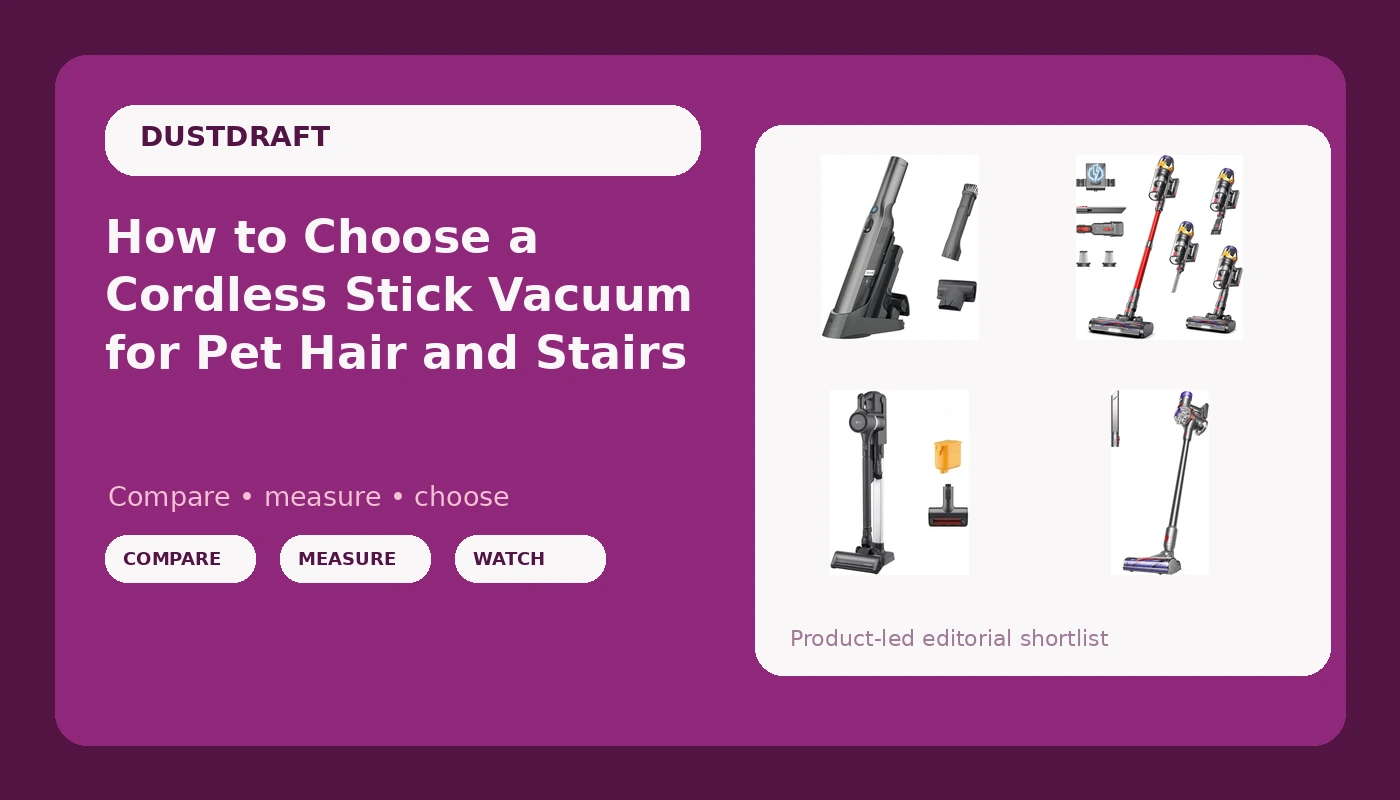
Shopping for a cordless stick vacuum in 2026 means sorting through listings that all shout the same three numbers: peak suction, maximum runtime, and a dust cup size that sounds enormous until you see it. The category has quietly split into distinct groups, and knowing which group you are shopping in matters far more than which number is largest. There are high-capacity sticks with self-standing bodies, renewed premium machines built around swappable batteries, familiar mid-range platforms with deep parts support, and small handhelds that exist for stairs, cars, and crumbs. This guide covers four currently available options, what each one is actually built to do, and the questions worth answering before you spend anything.
Related: Why Cordless Vacuum Runtime Shrinks on Carpet →
Quick answer
The right pick depends on three things: how much pet hair your home generates, whether you have stairs, and whether you are willing to wait for a charge. If you want the largest dust cup and the longest manufacturer-claimed runtime in this group, the high-capacity cordless stick with the 1.8L bin and anti-tangle brush roll is the most feature-dense option. If charging time is your bottleneck, the LG CordZero Kompressor (Renewed) is built around a swappable battery design. If you want a long-established platform with easy access to parts and tools, the Dyson V8 is the familiar choice. And if your real problem is stairs, car seats, and kitchen crumbs rather than whole floors, the Shark WANDVAC handheld is the one that gets used.
Four useful options
| Model | Best fit | What stands out |
|---|---|---|
| Cordless Vacuum Cleaner, Upgraded 55KPA 650W 70Mins Stick Vacuum with Hurricane Mode, Self-Standing, Touch Screen, 1.8L Dust Cup, Anti-tangle | Whole-home cleaning in pet households | Self-standing body, 1.8L dust cup, anti-tangle brush roll |
| LG CordZero Kompressor Cordless Stick Vacuum A941KTMP (Renewed) | Homes where charging time is the bottleneck | Kompressor bin system and swappable-battery design |
| Dyson V8 Cordless Vacuum | Buyers who want a proven, well-documented platform | Long-running cordless format with strong parts availability |
| Shark WV201 WANDVAC Handheld Vacuum | Stairs, cars, and quick pickups | 1.4-pound body with a charging dock and single-touch empty |
The high-capacity pick: Cordless Vacuum Cleaner, Upgraded 55KPA 650W 70Mins Stick Vacuum with Hurricane Mode, Self-Standing, Touch Screen, 1.8L Dust Cup, Anti-tangle
The number worth interrogating here is the runtime. A 70-minute figure is a manufacturer claim, and on cordless vacuums those numbers are almost always measured on the lowest power setting with a fresh battery and an empty bin. A 650W motor pulling hard in hurricane mode will drain the pack much faster, which is normal physics rather than a flaw. The practical question is whether the medium setting is enough for your floors, because that is the mode you will live in. The 1.8L cup is the genuinely unusual part: most sticks in this class hold a fraction of that, and a bigger cup means suction holds steadier through a full-house pass because the airflow path stays clearer.
The renewed value pick: LG CordZero Kompressor Cordless Stick Vacuum A941KTMP (Renewed)
Swappable batteries are the single most underrated feature in this category, because they change the failure mode. On a sealed-battery vacuum, a long cleaning session ends when the pack dies. On this one, a charged spare means the session continues, and the batteries also age independently, so replacing one does not retire the whole machine. The trade-off is condition. Renewed units can be excellent value, but battery health varies, so check what the specific seller includes, how long the warranty runs, and whether the listing states that the battery and charger are original LG parts.
The familiar everyday pick: Dyson V8 Cordless Vacuum
The case for a mature platform is boring and important. When a filter clogs or a battery weakens after a couple of years, you want replacements that are easy to find and easy to identify. On newer, less documented machines, you often cannot tell whether a part exists until you need it. The trade-off is that you are buying an established design rather than the newest feature set, so if a touch screen, a self-standing body, or a compressing bin is what you want, the other options here deliver those and this one does not. Read the bundle carefully, because tool kits vary by listing.
The handheld for stairs and cars: Shark WV201 WANDVAC Handheld Vacuum
Handhelds trade capacity and runtime for reach and weight, and that trade is worth making if your problem is localized. Stairs, car footwells, couch cushions, and the cereal zone under a high chair are all places where a full stick vacuum is awkward and a 1.4-pound handheld is easy. What you give up is whole-floor capability: the bin is small, and the runtime is short by design. Treat this as a companion to a main vacuum rather than a replacement, and the dock becomes the feature that matters most, because a handheld only gets used if it is charged and within arm's reach.
Prices and availability may change. Product images, names, and retailer links must be matched by verified ASIN. Do not state a current price, rating, stock status, or measured result without current evidence.
What the spec numbers actually tell you
Suction is the least standardized number on any vacuum box. Some listings quote pascals, some quote air watts, and some quote a marketing name like hurricane mode. Pascal figures measure sealed suction, which is the pull against a blocked hose, and they do not translate directly into how much grit comes off medium-pile carpet. Airflow matters more for surface debris, and airflow is what drops when a filter clogs or a bin fills. That is why two vacuums with identical suction ratings can feel completely different in a real room.
Runtime is the second number to read skeptically. Advertised minutes are typically measured on the lowest power setting, with a fresh battery, an empty bin, and no brush roll resistance. Thick carpet loads the brush roll, and loaded brush rolls draw more power. A vacuum advertised at 70 minutes might realistically deliver a fraction of that on the setting you would actually choose for carpet. None of this makes the claim false, it just means the number describes a best case.
Dust cup size is the third number, and it is the one most buyers ignore until week two. A small bin on a pet-heavy floor means stopping every few minutes, and every stop is friction. Large cups hold suction steadier because the cyclone path stays clear, but they also add weight. If you clean a whole house in one pass, bin size deserves more weight in your decision than peak suction does.
Pet hair, brush rolls, and the tangle problem
Pet hair is a mechanical problem, not a suction problem. Long strands wrap around a spinning brush roll, and once wrapped, the roll loses its ability to agitate carpet, which is where most of the deep cleaning happens. A tangle-free or anti-tangle brush roll is designed to shed hair as it spins rather than collecting it, and that single feature often decides whether a vacuum stays pleasant to use after a month.
The second pet-hair variable is the bin and filter path. Fine dander and short fur both clog filters faster than ordinary dust, and a clogged filter strangles airflow before the bin is anywhere near full. Washable filters help, but they need to actually dry completely before going back in, which means a spare filter is a practical accessory for pet homes.
Finally, consider where the hair accumulates. If it lives on open carpet, a full stick with a powered brush roll is the right tool. If it lives in a car, on upholstery, or on stair treads, a handheld with a narrow nozzle will do more useful work than a wide floor head.
A five-step way to narrow it down
- Measure your longest uninterrupted floor run, then compare it against the runtime you would get on medium power, not the headline number.
- Count your pets and their coat type. Double coats and long hair justify prioritizing an anti-tangle brush roll over a slightly higher suction claim.
- Decide whether stairs are part of your routine. If they are, weight and one-handed carry matter more than bin capacity.
- Check the dust cup against your tolerance for emptying. If stopping mid-clean irritates you, a large cup or a compressing bin is worth paying for.
- Decide how you feel about batteries. Swappable packs solve runtime anxiety, sealed packs keep the machine simpler and often lighter.
Practical details that decide it in week two
- Confirm the bin empties with one hand. A bin that needs two hands and a twist will annoy you every single time.
- Check whether the vacuum stands on its own, since a stick that has to be leaned against a wall will eventually fall over.
- Verify that the brush roll can be removed or cleaned without tools, because pet hair will get into it regardless of design.
- Look at what tools ship in the box. A crevice tool and an upholstery brush do more for stairs and cars than an extra power mode.
- Confirm filter availability and replacement intervals before buying, especially on renewed or less documented models.
Which option should you choose?
Choose the Cordless Vacuum Cleaner, Upgraded 55KPA 650W 70Mins Stick Vacuum with Hurricane Mode, Self-Standing, Touch Screen, 1.8L Dust Cup, Anti-tangle when you want the largest bin, a self-standing body, and a feature-dense spec sheet at the budget end of the range. Choose the LG CordZero Kompressor Cordless Stick Vacuum A941KTMP (Renewed) when charging time is your real bottleneck and you want swappable batteries plus a bin that compresses its own contents. Choose the Dyson V8 Cordless Vacuum when you would rather buy into a long-established platform where filters, batteries, and attachments are easy to source. Choose the Shark WV201 WANDVAC Handheld Vacuum when stairs, cars, and quick pickups are the jobs that actually need doing.
One caveat applies to all four. This is a comparison of what each product is designed and advertised to do, not a set of measured results from a test floor. Runtime figures, suction ratings, and bin capacities come from manufacturer listings and can vary with battery age, filter condition, floor type, and the mode you select. For the renewed unit in particular, condition and warranty terms are set by the individual seller, so read the listing details before you commit.
The bottom line
There is no single cordless stick vacuum that wins every home, and the spec sheet will not tell you which one fits yours. Start with the shape of your cleaning: whole floors in one pass points toward a large-bin stick or a swappable-battery machine, pet hair points toward an anti-tangle brush roll, and stairs and cars point toward a light handheld you can grab without thinking. Match the tool to the job, verify the runtime claim against the mode you will actually use, and treat the dust cup as a daily-use feature rather than a footnote. Do that, and the vacuum you buy will still make sense in month six.